
“Is Beowulf about a wolf?”
My husband (Christopher) and I exchanged knowing glances. Christopher was teaching Beowulf to his high school students, so we had been talking a lot about Old English literature. Now, over dinner, our seven-year-old son (Eliot) unknowingly cracked open a door that we were now about to kick in. “I am so glad you asked,” my husband replied as he took an Old English translation book out of his backpack. He went on to explain the plot of Beowulf, the significance of wergild, the anger of Grendel rising while hearing the songs of creation from the mead-hall (“So, Grendel is basically the Grinch, right?”), and the eventual fight with the dragon. It didn’t end there. I read aloud pieces in Old English followed by the modern translation. We talked about how language grows and changes.
After we cleaned up the kitchen, my husband put on The Hobbit movie so Eliot could see the dragon. Jack (age: five) sleepily rubbed his eyes and said he’d rather read Dragons Love Tacos by Adam Rubin in his bed. To each his own. I tucked Jack in with his story and later found Eliot in my room insisting that he must perfect his dragon drawing technique before going to bed. It would be a late night.
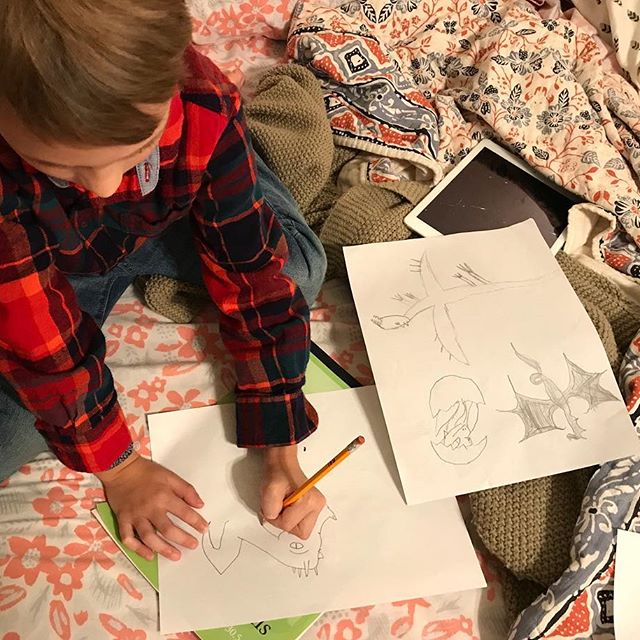
I am so thankful that when my sons show a shimmer of curiosity, they indulge us as we present them with a lecture. Such is the life of the child of English professors.
 Katie Robinson Writes